
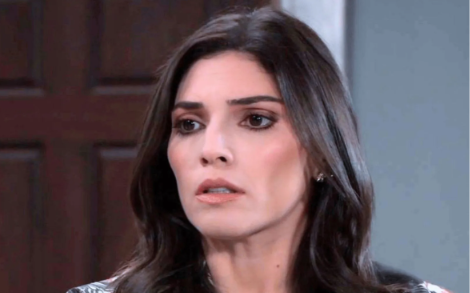
Sidwell gave the order, Cassius was forced to kill Liz General Hospital Spoilers
The sun may be setting on another idyllic day in Port Charles, but beneath the veneer of tranquility, a tempest is brewing. For loyal viewers of the iconic soap opera “General Hospital,” the machinations of powerful players are reaching a fever pitch, and one seemingly innocent pawn, Willow Kaine, finds herself caught in a web spun by ambitious and morally ambiguous forces. Whispers from the GH grapevine, amplified by devoted fan communities, suggest that the formidable Ross Cullum and his enigmatic associate, Andrew Hawks, are beginning to question the viability of their carefully constructed plan, with Willow as the linchpin.
The genesis of this precarious situation lies in the ambitious machinations of Jen Sidwell and Carlo Rooda. Their objective? To secure Drew Kane’s vacant congressional seat. In a move that initially appeared strategic and perhaps even beneficial to their broader ambitions, Sidwell and Rooda recruited Willow Kaine for this high-stakes political maneuver. The narrative, as revealed in the May 13th episode, painted a compelling picture of complicity. Sidwell’s interaction with Ross Cullum during that pivotal broadcast strongly indicated his awareness of, and initial tacit support for, his partner in crime’s arrangement with Willow. The overlapping agendas of Sidwell and Cullum are a recurring motif in Port Charles’ intricate power dynamics, suggesting that Cullum recognized the potential advantages of having Willow acting as an obedient proxy, a puppet master pulling strings from behind a seemingly benevolent facade. The prospect of influencing political decisions through a trusted, or at least controllable, individual was undoubtedly appealing to Cullum’s pragmatic and strategic mind.
However, the seemingly seamless partnership is now encountering unforeseen turbulence. The very foundation of Cullum’s support for the plan appears to be crumbling, replaced by a growing sense of perplexity and perhaps even apprehension. The article hints at a critical juncture where Cullum is now grappling with the “how” of Willow’s involvement, suggesting a disconnect or an unexpected development that has thrown his carefully calibrated strategy into disarray. This implies that Willow, despite her initial compliance, may be exhibiting an agency or developing an agenda that deviates from the script written for her.
The character of Willow Kaine, often portrayed as someone seeking stability and a sense of belonging, has been thrust into a role far exceeding her perceived capabilities. Her recruitment by Sidwell and Rooda was likely premised on the assumption of her docility and a desire to please those who offered her a path forward. Yet, the narrative is now hinting at a latent strength or a growing awareness within Willow. Is she truly a pawn, or is she a player in disguise, subtly manipulating the game to her own advantage? The ambiguity surrounding her motivations is precisely what makes this storyline so compelling. Could her initial compliance be a calculated ruse, a means to gain access and information before making her own decisive move? Or is she genuinely overwhelmed by the machinations of those around her, her own decisions being dictated by circumstances beyond her control?
The dynamic between Ross Cullum and Andrew Hawks is equally fascinating. Cullum, often depicted as the calculating strategist, thrives on order and predictability. Hawks, on the other hand, has often operated with a more elusive and perhaps even dangerous edge. Their partnership, while seemingly effective in the past, is now being tested. If Cullum is questioning Willow’s role, it suggests a potential fissure within their own alliance. Are they on the same page regarding the future of this congressional seat and Willow’s involvement? Or are their individual ambitions beginning to diverge, creating a rift that could be exploited by their enemies, or even by Willow herself? The article’s reference to Hawks as a potential decision-maker alongside Cullum highlights the collaborative yet potentially volatile nature of their partnership.
The broader impact of these unfolding events on Port Charles cannot be overstated. The congressional seat represents not just a political office, but a significant locus of power. Whoever controls it wields influence over legislation, public policy, and the very fabric of the community. The potential for Sidwell, Rooda, Cullum, and Hawks to manipulate this power for their own nefarious ends has long been a source of suspense for viewers. Willow’s entanglement, therefore, carries immense weight. If she is being used, it raises concerns about the integrity of the political process in Port Charles. If she is a participant, her rise to influence could be a catalyst for significant change, for better or for worse.
The phrase “isn’t worth the trouble” is a chilling indicator of the ruthlessness that defines the upper echelons of power in this fictional world. It suggests that if Willow becomes too unpredictable, too difficult to control, or too much of a liability, her protectors may be willing to discard her without a second thought. This raises the stakes for Willow immeasurably. Her survival, both politically and perhaps even physically, may depend on her ability to navigate this treacherous landscape with intelligence and cunning.
The anticipation surrounding the next developments is palpable. Fans are dissecting every clue, every hint, seeking to understand the true motivations of these characters and to predict the next seismic shift in Port Charles. Will Willow find a way to extricate herself from this web, or will she be consumed by it? Will Cullum and Hawks maintain their unified front, or will their own ambitions tear them apart? The answers to these questions will undoubtedly shape the future of “General Hospital,” promising a thrilling and dramatic narrative for weeks to come. The seemingly simple act of recruiting an individual for a political position has spiraled into a complex game of chess, where every move is scrutinized, and the potential for betrayal lurks around every corner. Port Charles, as always, remains a city where fortunes can be made and lost, and where the most dangerous battles are often fought not with fists, but with whispers and veiled intentions. The question remains: who will ultimately emerge victorious from this escalating power struggle?